print(“Hello, world!”)
Last week, I participated in my first ever graduate student writing retreat, where I sat in on a workshop session led by Luke LeGrand about the process of dissertation writing. From my perspective, while I have yet to publish or attend many conferences or even finalize my reading lists to prepare for exams, the thought of writing about research generally is at the top of my list of things to avoid in my daily life, let alone an entire dissertation. During that workshop, however, Luke shared that he started working on a blog to his advisors to share updates about his progress, ideas, and reflections on the journey so far. For whatever reason, that idea really resonated with me.
So, here we are, and it’s time to execute the code:
Hello, World!
If you’re wondering where this blog posting journey begins, let’s say we’re in media res when it comes to my scholarly journey. I am just finishing up coursework, and the reality of avoiding publications and conferences or answering the question of “what do you want to focus your research on?” has finally caught up to me. I’ve spend the last semester thus having a bit of a scholarly identity crisis, trying to figure out if I’m a linguist, or a historian, or an urban studies researcher, or a media scholar, or a rhetoric and composition scholar, seeing if I can put on one of the many hats I have donned while in my interdisciplinary PhD program. What I have discovered recently, however, is that these are the wrong questions to ask– instead, I am finding myself more drawn to the meaning of the work I already do, and the direction that is pulling me, in a manner that is reminiscent of Deleuze and Guattari’s Body without Organs1:
This is how it should be done. Lodge yourself on a statum, experiment with the oppurtunities it offers find an advantageous place on it, find potential movements of deterritorialization, possible lines of flight, experience them, produce flow conjunctions here and there, try out continuums of intensities segment by segment, have a small plot of new land at all times.
Here is where I find myself at this turning point in my PhD journey, trying to identify an organizing structure that renders my work legible to my committee members and the job market I am to face in coming years. So, how exactly does a BwO write a statement of research? How can lines of fight be materialized as lines on a CV? Is it not perverse to even attempt such a thing?
I don’t have any answers to these questions, and I don’t pose them as answerable, but as I went on a walk this morning and pondered what I’d write about for this first post, I found myself again drawn to the beauty of D&G’s ontological perspective. I, too, feel like a machine, one that is always desiring production. Not production of the kind that gets you a nice job offer or gets you to respond to all of your emails in a timely manner. No, to desire production for me is to reject confinement to a body, to experiment, to refuse equating production with presentation of product.
Can a line of flight begin with a hop?
In my free time, I often like to watch videos about a variety of hobbyist topics. One area that I have found describes one dimension of my work is critical making (Ratto, 2011)2, and my scholarly interets in 3D printing, microcontrollers, and programming often extends into how I spend that leisure time. As part of this scholarly-play practice, I enjoy watching videos from Benn Jordan, a musician, content creator, and independent researcher who recently shared a video entitled “Gadgets For People Who Don’t Trust The Government.” Part commentary on anarchist practices and part microcontroller tutorial, I was especially drawn to his segment on Meshtastic, a mesh network that employs radio devices to enable encrypted off-grid communication, no internet needed.
A few package delivery orders and Youtube tutorials later, and there I was earlier today, during that morning walk around my neighborhood holding a radio antenna in the air in an attempt to find other user nodes.
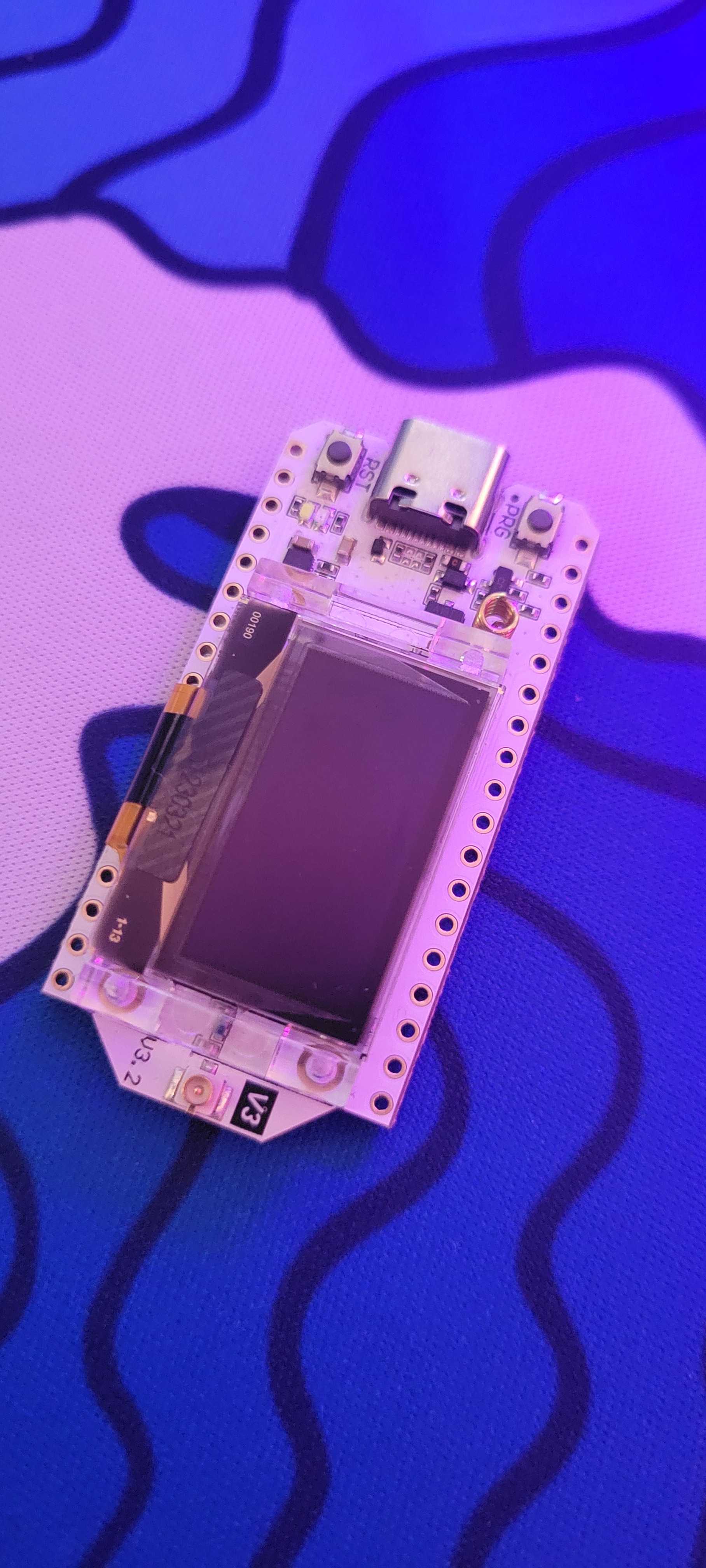
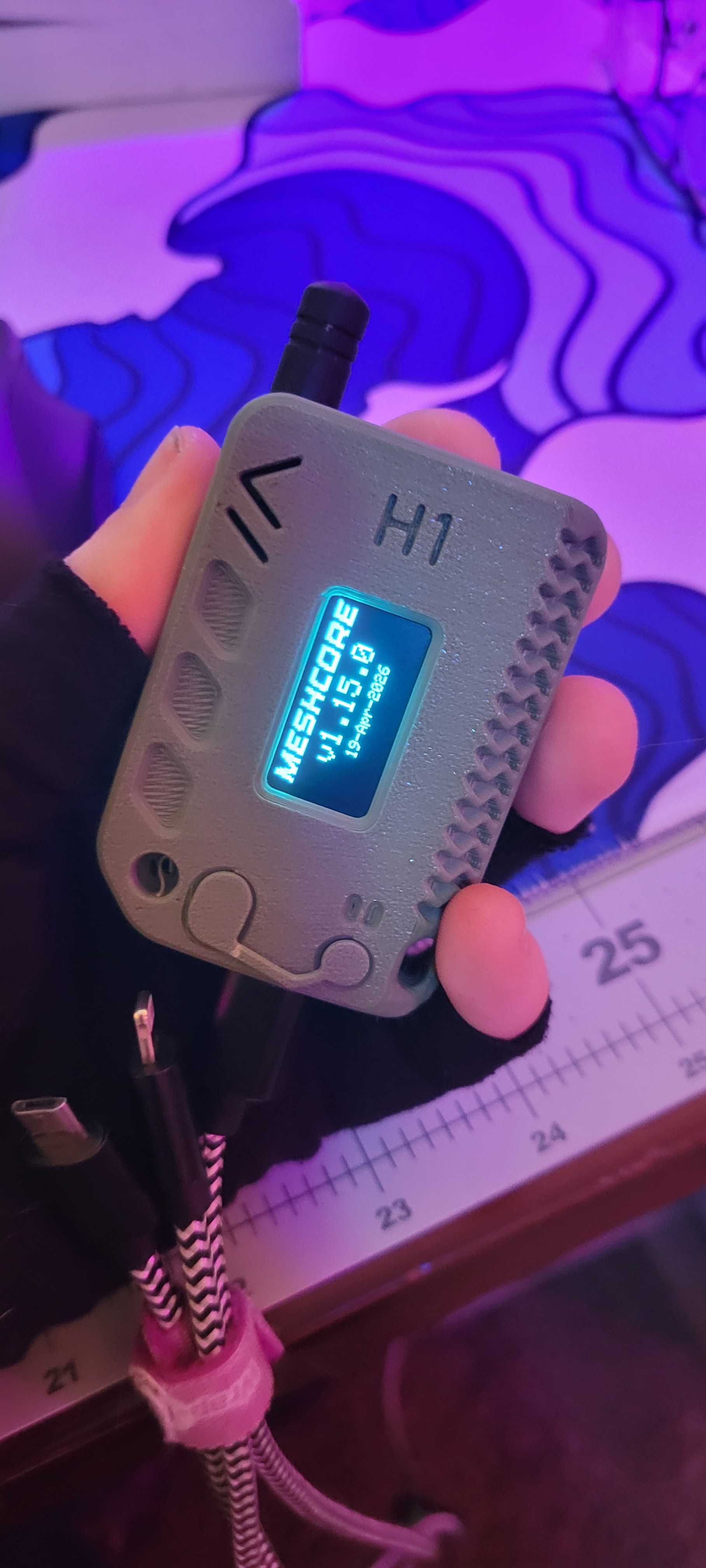
The particular unit I put together works with essentially two components:
- A Heltec V3 ESP32 board with a LoRa compatible antenna
- An enclosure for the board and antenna that was 3D printed using PLA filament
From there, I searched for information about mesh users in my area. Thankfully, being in a city, there is already ample radio infrastructure near me that made it easy to go ahead and connect with other users. I joined NC Mesh, which is the mesh network group for my state, and I found that they tend to use Meshcore as their preferred mesh platform, so I flashed the firmware onto the Heltec board, downloaded the corresponding app onto my phone, and I sent my first ever transmission out into the ether.
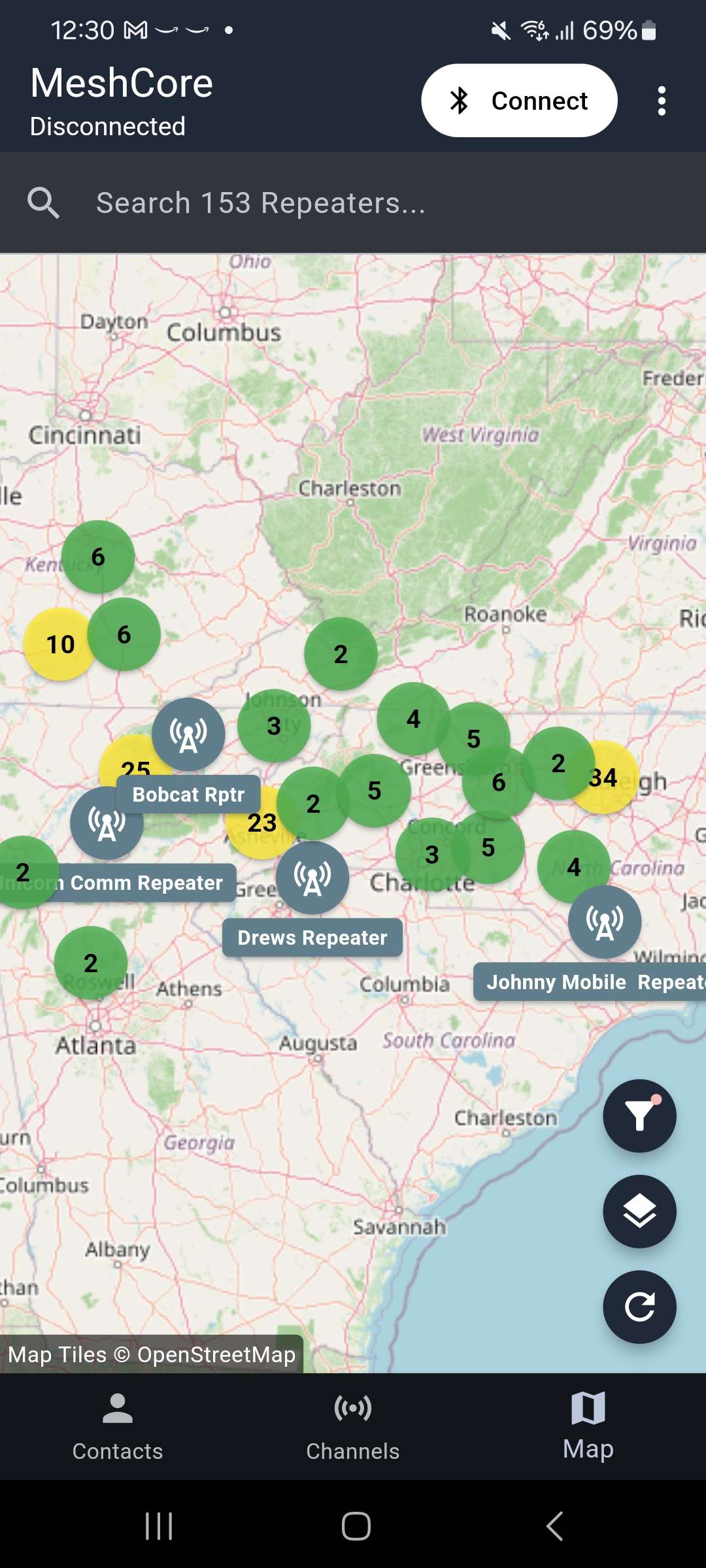
My transmission made it to one repeater, and then another, and another. Suddenly, my device’s map populated with dozens of repeater nodes that were acting as a kind of telephone or notepassing system, “hopping” my message from one node to the next. No internet or data required. Passing my greeting to the mesh network through radio waves alone.
Talk about a line of flight, indeed.
A new plot of land at all times
This is the hope of this blog, to grapple with the problems that the kinds of experiments, unanswered questions, and unanticipated roadblocks that emerge in the process of producing scholarship, especially when that work is multimodal or involves critical making. Perhaps a blog post can be much like a radio message, transmitted without requiring or demanding that it being received, sending ideas out and waiting to see where the signal reaches. As I look at the many maker projects I have tucked in the makerspace room I have constructed in my apartment, I see possibilities for more posts, which may become presentations or publications, but also an assemblage of scholarly practice that can be constructed in this space over time.
blog post transmitting…
…
…
…
…over
References